Retatrutide in the UAE
Retatrutide (LY-3437943) is an investigational GLP-1/GIP/glucagon triple-agonist peptide. It is not approved or registered for medical use in the UAE by MoHAP, the FDA, or the EMA, and remains in Phase 3 trials. This page explains its UAE availability and legal status, summarises the published TRIUMPH evidence, and documents the research formats and archived batch records Remy Peptides publishes for in-vitro laboratory research reference only.
- Investigational · Phase 3 TRIUMPH
- Not MoHAP / FDA / EMA approved
- Janoshik-tested batches
- GLP-1 / GIP / glucagon agonist
For wider market context, see the Retatrutide Dubai guide, the Retatrutide Abu Dhabi guide, and the approval-status tracker. Mechanism and the full literature trail live in the retatrutide research hub. Updated July 25, 2026.
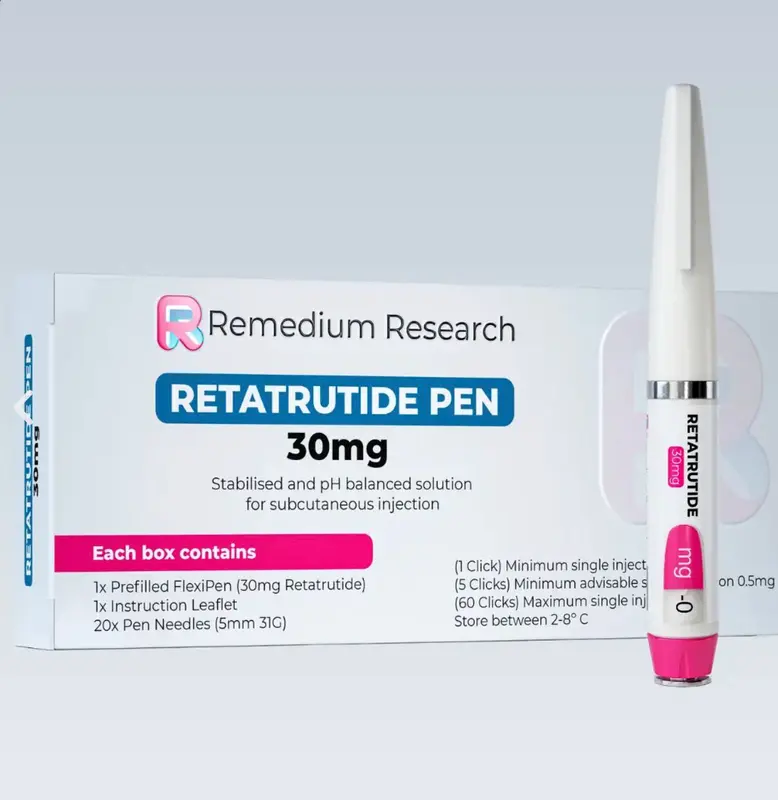
Supplied for in-vitro laboratory research only. Material must not be frozen and should remain protected from light.
Retatrutide UAE: what it is, its status, and how it’s documented.
Retatrutide (LY-3437943), often shortened to “reta”, is an investigational triple-agonist peptide studied for obesity and metabolic disease across Eli Lilly’s Phase 3 TRIUMPH programme. It is not approved or registered as a medicine in the UAE — it has no MoHAP, FDA, or EMA marketing authorisation — so it reaches UAE researchers as a research-use compound, not a prescription product. As a research material it is documented here in six formats (prefilled pens and lyophilised vials); five of the six carry an archived independent Janoshik Certificate of Analysis, and no certificate was ever published for the 10mg pen. For the adjacent dual-agonist, compare the tirzepatide research vial reference. For Research Use Only — not for human or veterinary use.
On this page: UAE legal & approval status, the TRIUMPH trial evidence, the research formats, and batch COA documentation.
- Regulatory status: not approved or registered as a UAE medicine (no MoHAP, FDA, or EMA authorisation); handled research-use only.
- Formats documented: six research formats — 30mg, 20mg, 10mg, and 40mg prefilled pens plus 10mg and 40mg vials.
- Trial stage: Phase 3 TRIUMPH programme (TRIUMPH-1 through TRIUMPH-4); no regulatory filing confirmed.
- Storage: 2–8°C, protected from light, never frozen — the stability parameters recorded on the batch certificates.
- COA / purity proof: each archived batch carries an independent Janoshik Certificate of Analysis; flagship batch RETP002 tests at 99.262% HPLC purity.
The documented formats
The most-cited format on this page is the Retatrutide 30mg pen, whose batch RETP002 tested at 99.262% HPLC purity with Janoshik Analytical. All six documented formats are compared below. For Research Use Only.
Is retatrutide legal or approved in the UAE? Its current regulatory status.
Quick answer: Retatrutide is not approved or registered as a medicine anywhere — it holds no UAE MoHAP, US FDA, or EMA marketing authorisation and remains in Eli Lilly’s Phase 3 TRIUMPH programme. In the UAE it is handled only as a research-use material, not as a prescription drug.
Retatrutide is an investigational compound: it is not a registered UAE medicine and holds no marketing approval anywhere in the world. In the UAE it is handled under research-use rules rather than as a prescription drug. Here is what that means for its approval, legal framing, and availability.
Approval status
Retatrutide is not approved by the UAE MoHAP, the US FDA, or the EMA. It remains in Eli Lilly’s Phase 3 TRIUMPH programme and is not registered as a UAE pharmacy medicine for obesity or any other indication.
Legal & research-use framing
Because it is unapproved, retatrutide sits only in the research-use category — for in-vitro laboratory research, not for human or veterinary use. UAE health authorities have publicly warned against unauthorised retatrutide weight-loss products marketed to consumers.
Availability
As a research compound it is available to UAE researchers through documented suppliers that publish batch COAs; it is not available as an approved prescription. Individuals can access retatrutide for treatment only by enrolling in a supervised clinical trial.
Is retatrutide approved in the UAE?
No. Retatrutide holds no UAE MoHAP, US FDA, or EMA marketing authorisation and is not a registered pharmacy medicine. It remains investigational in Eli Lilly’s Phase 3 TRIUMPH programme, and in the UAE it sits only in the research-use category.
How is retatrutide documented for UAE research use?
Through published batch analytics. Six research formats are documented on this page; five are tied to an archived independent Janoshik Certificate of Analysis in the COA library, and the 10mg pen has none published. Channel-authenticity references are published on the contact verification page. For in-vitro laboratory research only.
Is retatrutide better than semaglutide?
In published trial data, retatrutide’s triple-agonist design reported a higher mean weight change than single-agonist semaglutide — about 24% at 48 weeks in the phase 2 study versus roughly 15% for semaglutide over comparable durations. Retatrutide remains investigational, so this reflects trial observations, not a treatment claim.
The research formats documented in the UAE: 30mg, 20mg, 10mg, and 40mg pens plus 10mg and 40mg vials.
Six Retatrutide research formats are documented here: 30mg pen (batch RETP002, 99.262% HPLC purity), 20mg pen (RET-20-C-2604-001, 99.841%), 10mg pen (COA never published), 40mg pen (RET-20-V-2604-001, 99.741%), 10mg vial (RET-20-V-2604-001, 99.741%), and 40mg vial (RT-40-V-001, 99.692%, sterility-tested). The archived Janoshik certificates are in the COA library. Same molecule across formats — seal level, batch documentation, and reconstitution burden are what differ.
| Format | Documentation | Reconstitution | Total Peptide | Batch record |
|---|---|---|---|---|
| Retatrutide 30mg Pen | Batch RETP002 · public COA | None — sealed pen | 30mg | RETP002 certificate → |
| Retatrutide 20mg Pen | Batch RET-20-C-2604-001 · public COA | None — sealed pen | 20mg | RET-20-C-2604-001 certificate → |
| Retatrutide 10mg Pen | No COA published | None — sealed pen | 10mg | None published |
| Retatrutide 10mg Vial | Batch RET-20-V-2604-001 · public COA | Bacteriostatic water required | 10mg lyophilised | RET-20-V-2604-001 certificate → |
| Retatrutide 40mg Vial | Batch RT-40-V-001 · public COA | Bacteriostatic water required | 40mg lyophilised | RT-40-V-001 certificate → |
| Retatrutide 40mg Pen | Batch RET-20-V-2604-001 · public COA | None — sealed pen | 40mg | RET-20-V-2604-001 certificate → |
Click counts, mg-per-click conversions, and protocol math live on the reconstitution and click calculator and the mg-to-click lookup. Phase 3 titration windows are documented in the Phase 3 titration schedule.
30mg pen
Longest sealed-device route. Janoshik batch RETP002 published. No mixing step.
20mg pen
Highest published purity across the archived batches (99.841%). Sealed pen, no mixing step.
10mg pen
Smallest sealed-pen format. No reconstitution step. No batch COA was ever published for this format.
10mg vial
Smallest lyophilised vial format. Documented on the same Janoshik vial-line batch as the 40mg pen, RET-20-V-2604-001.
40mg vial
Largest lyophilised vial format documented here, on its own sterility-tested batch RT-40-V-001 with a full microbial panel.
40mg pen
Largest sealed-pen format — 40mg in a prefilled FlexiPen, Janoshik vial-line batch RET-20-V-2604-001 at 99.741%. No reconstitution step.
What the TRIUMPH trials show. Triple receptor mechanism, endpoints, and reported safety signals.
Retatrutide is a triple receptor agonist acting on the GLP-1, GIP, and glucagon pathways — engaging three metabolic receptors across three hormone pathways involved in appetite regulation, energy balance, and glucose handling. It acts on glucagon-like peptide-1 (GLP-1), glucose-dependent insulinotropic polypeptide (GIP), and glucagon signalling; this triple receptor mechanism is studied for its influence on appetite, food intake, and overall metabolic function and metabolic health. In Eli Lilly’s Phase 3 TRIUMPH programme, published readouts report endpoints across body weight, visceral fat, insulin sensitivity, HbA1c, and blood pressure, with the compound given once weekly by subcutaneous injection in the trial protocol. Earlier Phase 2 data published in the New England Journal of Medicine reported weight reduction of up to 24.2% in study participants at the highest dose; by comparison, semaglutide targets one receptor while retatrutide targets three. On safety, the most commonly reported events involve the gastrointestinal system — nausea, diarrhea, vomiting, constipation, reduced appetite, and changes in bowel habits, concentrated during dose escalation. In the Phase 3 TRIUMPH-1 readout, dysesthesia was reported in up to 12.5% of participants at the 12 mg study dose, and adverse-event-driven discontinuation rose with dose, from 4.1% at 4 mg to 6.9% at 9 mg and 11.3% at 12 mg, versus 4.9% on placebo. No serious organ-level safety signals have been identified in trials, but ongoing research and ongoing monitoring still matter because retatrutide remains investigational. This describes clinical-trial data, not instructions for use.
In the phase 2 trial (NEJM 2023), participants receiving the highest retatrutide dose showed a mean body-weight reduction of about 24% at 48 weeks.
Full mechanism, the trial-by-trial breakdown, and the literature trail live in the retatrutide research hub; see also the triple-agonist comparison and the approval-status tracker. Published for in-vitro laboratory research reference only.
Retatrutide purity & batch reference. All six formats, five with archived certificates.
Quick answer: Five of the six documented retatrutide formats carry an archived independent Janoshik Analytical HPLC Certificate of Analysis; the 10mg pen never had one published. Recorded purities run from 99.262% (30mg pen, RETP002) to 99.841% (20mg pen, RET-20-C-2604-001).
Third-party HPLC purity, batch number, test date, and a direct link to the archived certificate for each documented Retatrutide format.
The Retatrutide 30mg Pen and 20mg Pen are distinct format lines, not one format documented two ways — different molds, different fill specs, different batches. The vials are documented per batch too: the 10mg vial on RET-20-V-2604-001, and the 40mg vial on its own sterility-tested batch RT-40-V-001 with a full microbial panel plus heavy metals, residual TFA, and bacterial endotoxin.
How to verify a retatrutide batch claim. Certificate, lab, and channel.
Any purity figure quoted for a retatrutide research format should trace back to a named laboratory, a named batch, and a retrievable certificate. That is why every Janoshik Analytical Certificate of Analysis Remy Peptides has ever cited stays published in the COA library, with the full analytical panels mirrored in the lab results archive — batch IDs, HPLC purity, assay, test dates, and, for the 40mg vial, the sterility panel. Channel-authenticity references (which accounts and addresses are genuinely ours) are published on the contact verification page, and the sourcing rules behind these pages are set out in our research standards. For Research Use Only — not for human or veterinary use.
Per-format purity and batch IDs are in the batch reference above; reconstitution and click math live on the calculator.
Verify the batch.
Verify the channel.
Five of the six documented retatrutide formats have a matching Janoshik Analytical Certificate of Analysis on file; the 10mg pen has none published. The 30mg pen record below is one of four published batch reports — the 20mg pen, the 10mg vial, and the sterility-tested 40mg vial each have their own. Cross-check any batch against the COA library, and confirm which public channels are genuinely ours on the contact-verification page.

What do you need first?
Need dosage detail?
Phase 3 titration schedule and study-design context. Lives in the research library, not on this format page.
Need legality?
UAE legal context for research peptides, MoHAP framing, and import boundaries.
Need approval status?
FDA, EMA, and MoHAP approval timeline plus the live TRIUMPH trial tracker.
Need COA methodology?
How to read an HPLC certificate: purity, assay, endotoxin, TFA, and heavy-metals fields.
Need click math?
Reconstitution and click calculator. Dose math lives there, not on this format page.
Need mechanism & literature?
The retatrutide research hub — covers the triple-agonist mechanism, showing how retatrutide targets three receptors—GLP-1, GIP, and glucagon—involved in appetite regulation and metabolic processes, plus trial map, side-effect data, and the full literature trail.
Need the batch records?
Archived Janoshik Analytical certificates for every batch cited on this site — kept public so the numbers stay checkable.
Retatrutide UAE — availability, legality, and approval.
Direct answers to the questions most asked about retatrutide in the UAE. For wider market context, see the Retatrutide Dubai guide; for the batch records, the COA library.
Is retatrutide available in the UAE?
Direct answer: Not as an approved medicine. Retatrutide has no MoHAP, FDA, or EMA authorisation and is still in Phase 3 trials, so it is not a UAE pharmacy product. It reaches UAE researchers only as a research-use compound. Six formats are documented here — 30mg, 20mg, 10mg, and 40mg pens plus 10mg and 40mg vials — and five of them are tied to an archived independent Janoshik COA; the 10mg pen has none published. For in-vitro laboratory research only, not for human or veterinary use.
Compare the formats: format reference table.
Is retatrutide legal in the UAE?
Direct answer: Retatrutide is not a registered or approved medicine in the UAE, so it cannot be marketed or used as a treatment. It appears only as a research-use material — in-vitro laboratory research, not human or veterinary use. UAE health authorities have warned the public against unauthorised retatrutide weight-loss products.
Legal context: are peptides legal in Dubai?
When will retatrutide be approved, and how would a researcher verify a batch?
Direct answer: No approval date is confirmed — retatrutide is still completing the Phase 3 TRIUMPH programme before any regulatory filing, and for treatment the only legitimate access is enrolment in a supervised clinical trial. To check a research-use batch claim, trace it to a named laboratory, a named batch ID, and a retrievable certificate; the ones cited on this site are archived in the COA library, with channel-authenticity references on the contact verification page. For in-vitro laboratory research only.
Approval timeline: is retatrutide approved?
Retatrutide UAE — Research, evidence and COA FAQ
Is Retatrutide available in the UAE?
What is retatrutide (LY-3437943)?
Is Retatrutide approved in the UAE?
What is Batch RETP002?
Retatrutide UAE: what formats are available?
Which Retatrutide format has the highest published purity?
How do the six documented formats differ — 30mg pen, 20mg pen, 10mg vial, or 40mg vial?
What side effects or safety signals were reported in retatrutide trials?
How is Retatrutide administered in clinical research?
How does Retatrutide work in research models?
Who is Retatrutide being studied for?
How were the archived batches verified?
How was the material in the archived batches manufactured?
What is the research status of Retatrutide?
What should be considered when handling Retatrutide research material?
How does Retatrutide fit into global peptide research?
Verify the evidence before you decide
1. Check the approval status · 2. Read the trial evidence · 3. Review the batch COAs
Remy Peptides · For in-vitro laboratory research only. Not for human or veterinary use. Research Use Only