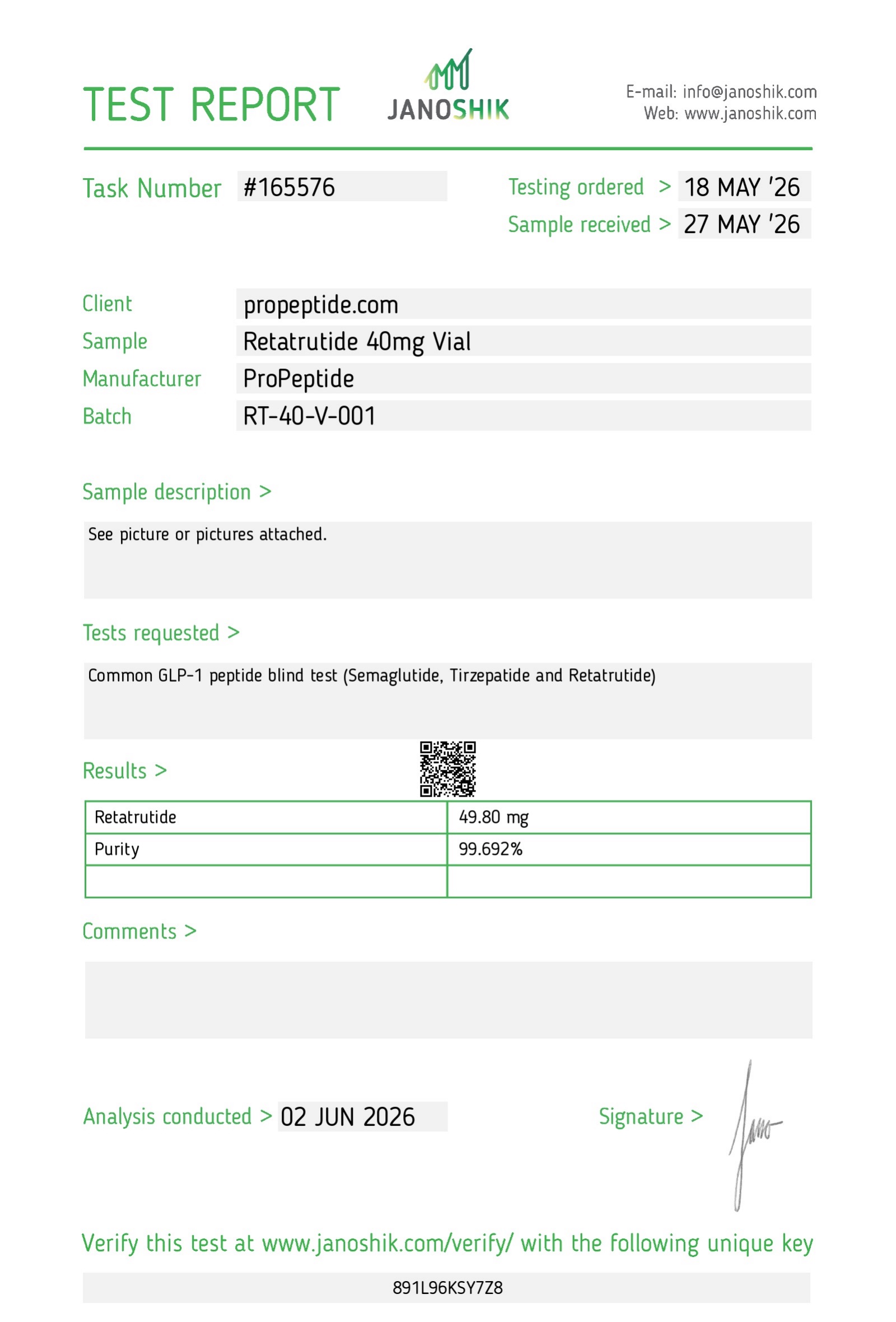
The Retatrutide 40mg vial is the bulk lyophilized format in the vial line, and our most thoroughly tested batch. Batch RT-40-V-001 returned 99.692% HPLC with assay 49.80 mg, a full microbial sterility panel (TAMC and TYMC both pass), bacterial endotoxin under 1 EU/Vial by LAL, heavy metals not detected, and residual TFA not detected. To our knowledge it is the only Retatrutide research vial in the UAE published with a full sterility panel. Designed for extended research protocols where vial-count economics matter. The full Janoshik report set is mirrored at /coa/rt-40-v-001/.
Batch Facts
- Product
- Retatrutide 40mg Vial (lyophilized, bulk format)
- Batch number
RT-40-V-001(dedicated 40mg vial batch)- Molecule
- Retatrutide (LY-3437943), CAS 2381089-83-2
- Purity (HPLC)
- 99.692%
- Assay
- 49.80 mg retatrutide
- Sterility (TAMC / TYMC)
- Pass / Pass
- Heavy metals
- As, Cd, Pb, Hg — not detected
- Residual TFA
- Not detected
- Bacterial endotoxin
- under 1 EU/Vial (LAL method)
- Test method
- HPLC reverse-phase · TAMC/TYMC microbial limits · ICP-MS · HPLC for residual TFA · LAL for endotoxin
- Laboratory
- Janoshik Analytical — EU, independent third-party
- Analysis dates
- 1–16 June 2026
- Verification key (purity)
891L96KSY7Z8- Verification key (sterility)
7HDEPPG16HDB- Verification key (endotoxin)
UYLI4AFJK4SV- Format
- 40mg lyophilized vial (bulk format for extended protocols)
- Storage
- 2–8°C, cold-chain shipping
The Test
Batch RT-40-V-001 is the 40mg vial's own dedicated retatrutide lot, and the most thoroughly documented batch in the Remy range. The Janoshik workup covers five distinct measurements, each on a separate certificate: HPLC purity and assay, microbial sterility (TAMC and TYMC), bacterial endotoxin, heavy metals, and residual TFA. The smaller 10mg vial ships under the earlier vial-line batch RET-20-V-2604-001.
HPLC purity (reverse-phase, C18). The retatrutide fraction is separated from peptide-related impurities — truncated sequences, deletion variants, synthesis byproducts — on a C18 stationary phase, then quantified against the reference retention time for the parent peptide (LY-3437943, CAS 2381089-83-2). The reported 99.692% figure is the area-under-the-curve percentage for the parent peak, normalised against the sum of all peptide-related peaks. Assay measured 49.80 mg retatrutide per vial of fill weight, confirming the labelled quantity for the lot.
Heavy metals (ICP-MS). The four heavy-metal contaminants of pharmacopoeial interest — arsenic, cadmium, lead, mercury — were each measured by ICP-MS and reported as not detected at the relevant limits of quantification. On a lyophilized vial, any heavy-metal trace is concentrated rather than diluted, which is why the test matters more on the vial format than on a pre-formulated pen.
Residual TFA. Trifluoroacetic acid is a common counter-ion in solid-phase peptide synthesis and a frequent residual on insufficiently exchanged peptide lots. Janoshik measured residual TFA and reported it as not detected. For triple-agonist work where receptor binding assays are downstream, removing TFA matters because it can interfere with cell-based readouts.
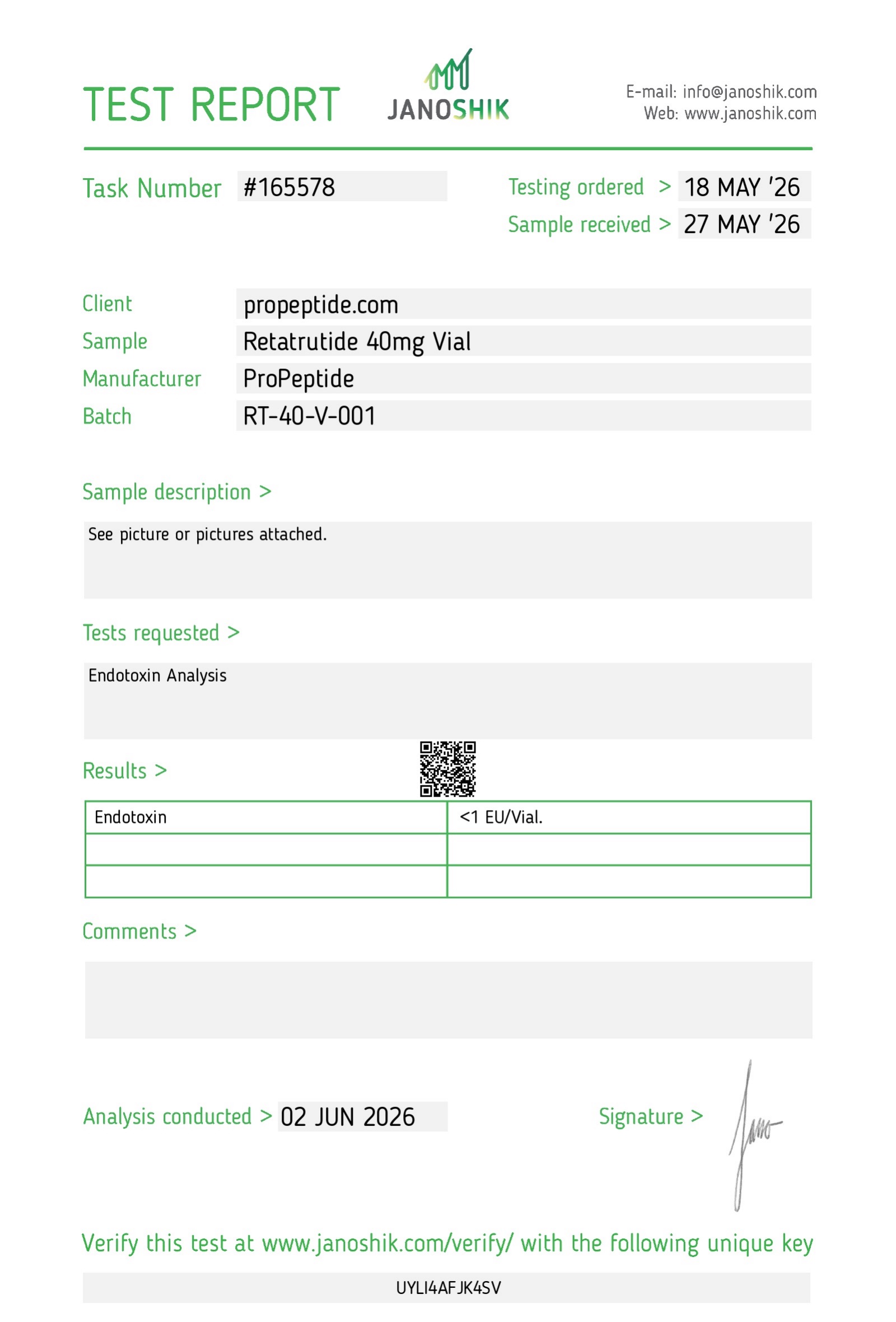
Bacterial endotoxin (LAL). The Limulus Amebocyte Lysate (LAL) test quantifies bacterial endotoxin — lipopolysaccharide fragments that can persist through synthesis and fill steps. RT-40-V-001 measured under 1 EU/Vial. Endotoxin is the panel most directly relevant to in-vitro cell work that wants to control for confounding immune signalling.
Microbial sterility (TAMC + TYMC). Total Aerobic Microbial Count and Total Combined Yeasts and Moulds Count are the microbial-limits tests pharma uses to confirm a lot is free of significant bacterial, yeast and mould growth. Batch RT-40-V-001 passed both. Most research peptide sellers stop at HPLC; to our knowledge this is the only Retatrutide research vial in the UAE published with a full sterility panel, which is what makes it the documentation-first option in the Remy range.
What This Means For Researchers
The 40mg vial is the bulk format in the vial line. For extended research protocols — longer in-vitro time courses, repeated assay runs, multi-arm experiments where the same lot needs to back several conditions — using one larger vial rather than four 10mg vials reduces per-vial reconstitution variance and keeps the published Janoshik panel consistent across the work. The 99.692% HPLC purity, 49.80 mg assay, passing TAMC/TYMC sterility result, under-1 EU/Vial endotoxin, and undetectable heavy metals and TFA make this the most completely documented vial in the line.
Retatrutide is a triple-receptor agonist engaging GIP, GLP-1, and glucagon receptors with a single molecule. Triple-agonist potency is highly sensitive to sequence integrity: any truncation or deletion variant alters receptor binding for at least one of the three pathways, which is what makes HPLC purity verification meaningful. At 99.692% HPLC, RT-40-V-001 sits in the same band as the rest of the Remy Retatrutide line (30mg pen 99.262%, 20mg pen 99.841%) — inter-batch variation of 0.1–0.6% is normal and reflects analytical precision rather than systematic differences in synthesis. The bulk vial extends that comparability across longer studies without batch transitions in the middle.
The Full Report
HPLC purity report from Janoshik Analytical for batch RT-40-V-001 (99.692%, verification key 891L96KSY7Z8).
Bacterial endotoxin (LAL) report from Janoshik Analytical for batch RT-40-V-001 (under 1 EU/Vial, verification key UYLI4AFJK4SV). The sterility (TAMC/TYMC), heavy metals and residual TFA reports are linked from the batch page.
Frequently Asked
What is the HPLC purity of the Retatrutide 40mg Vial?
RT-40-V-001. Analysis dates 1–16 June 2026. The same batch also passed a full sterility panel (TAMC and TYMC), bacterial endotoxin under 1 EU/Vial, with heavy metals and residual TFA not detected.
What batch does the Retatrutide 40mg vial ship under?
RT-40-V-001, with a batch-matched Janoshik COA. It carries the most complete panel in the Remy range: 99.692% HPLC, 49.80 mg assay, microbial sterility (TAMC and TYMC pass), bacterial endotoxin under 1 EU/Vial, with heavy metals and TFA not detected. The 10mg vial ships under the earlier vial-line batch RET-20-V-2604-001.
What sterility testing does the Retatrutide 40mg vial carry?
RT-40-V-001 carries a full microbial sterility panel — Total Aerobic Microbial Count (TAMC) and Total Combined Yeasts and Moulds Count (TYMC), both pass — plus bacterial endotoxin under 1 EU/Vial by LAL, heavy metals (As, Cd, Pb, Hg) not detected, and residual TFA not detected. To our knowledge this is the only Retatrutide research vial in the UAE published with a full sterility panel; most research peptide sellers stop at HPLC. Verification keys: 891L96KSY7Z8 for purity, 7HDEPPG16HDB for sterility, UYLI4AFJK4SV for endotoxin.