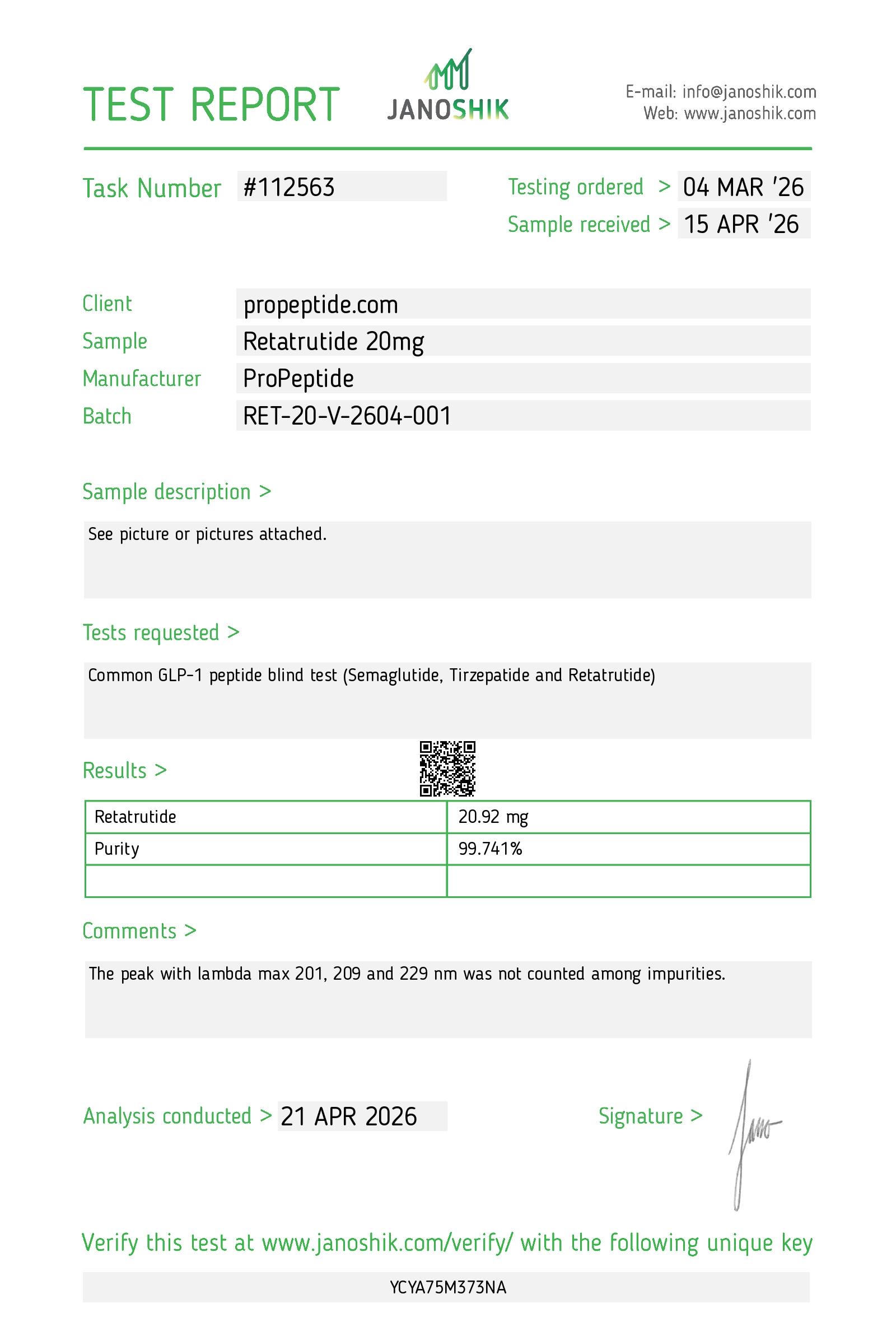
The Retatrutide 10mg lyophilized vial ships against batch RET-20-V-2604-001, sent to Janoshik Analytical for a four-panel workup: HPLC purity, heavy metals, residual TFA, and bacterial endotoxin (LAL). Result: 99.741% HPLC, 20.92 mg assay, As/Cd/Pb/Hg not detected, residual TFA not detected, endotoxin 1.449 EU/Vial. This documentation-first panel — HPLC alongside a sterility-grade workup — is rarely published by research peptide sellers. The full Janoshik report set is mirrored at /coa/ret-20-v-2604-001/.
Batch Facts
- Product
- Retatrutide 10mg Vial (lyophilized)
- Batch number
RET-20-V-2604-001- Molecule
- Retatrutide (LY-3437943), CAS 2381089-83-2
- Purity (HPLC)
- 99.741%
- Assay
- 20.92 mg retatrutide
- Heavy metals
- As, Cd, Pb, Hg — not detected
- Residual TFA
- Not detected
- Bacterial endotoxin
- 1.449 EU/Vial (LAL method)
- Test method
- HPLC reverse-phase · ICP-MS · HPLC for residual TFA · LAL for endotoxin
- Laboratory
- Janoshik Analytical — EU, independent third-party
- Analysis dates
- 21–24 April 2026
- Verification key (purity)
YCYA75M373NA- Verification key (endotoxin)
E8ZFE17MI47D- Format
- 10mg lyophilized vial
- Storage
- 2–8°C, cold-chain shipping
The Test
Batch RET-20-V-2604-001 is the lot behind the 10mg vial; the 40mg vial now ships under its own dedicated lot, batch RT-40-V-001, with a fuller panel. The 10mg-vial workup below covers four distinct measurements, each on a separate certificate.
HPLC purity (reverse-phase, C18). The retatrutide fraction is separated from peptide-related impurities — truncated sequences, deletion variants, synthesis byproducts — on a C18 stationary phase, then quantified against the reference retention time for the parent peptide (LY-3437943, CAS 2381089-83-2). The reported 99.741% figure is the area-under-the-curve percentage for the parent peak, normalised against the sum of all peptide-related peaks. Assay measured 20.92 mg retatrutide per vial of fill weight, confirming the labelled quantity.
Heavy metals (ICP-MS). The four heavy-metal contaminants of pharmacopoeial interest — arsenic, cadmium, lead, mercury — were each measured by ICP-MS and reported as not detected at the relevant limits of quantification. This panel speaks to the upstream synthesis and the dry-fill process; on a lyophilized vial, any heavy-metal trace is concentrated rather than diluted, which is why the test matters more on the vial format than on a pre-formulated pen.
Residual TFA. Trifluoroacetic acid is a common counter-ion in solid-phase peptide synthesis and a frequent residual on insufficiently exchanged peptide lots. Janoshik measured residual TFA and reported it as not detected. For triple-agonist work where receptor binding assays are downstream, removing TFA matters because it can interfere with cell-based readouts.
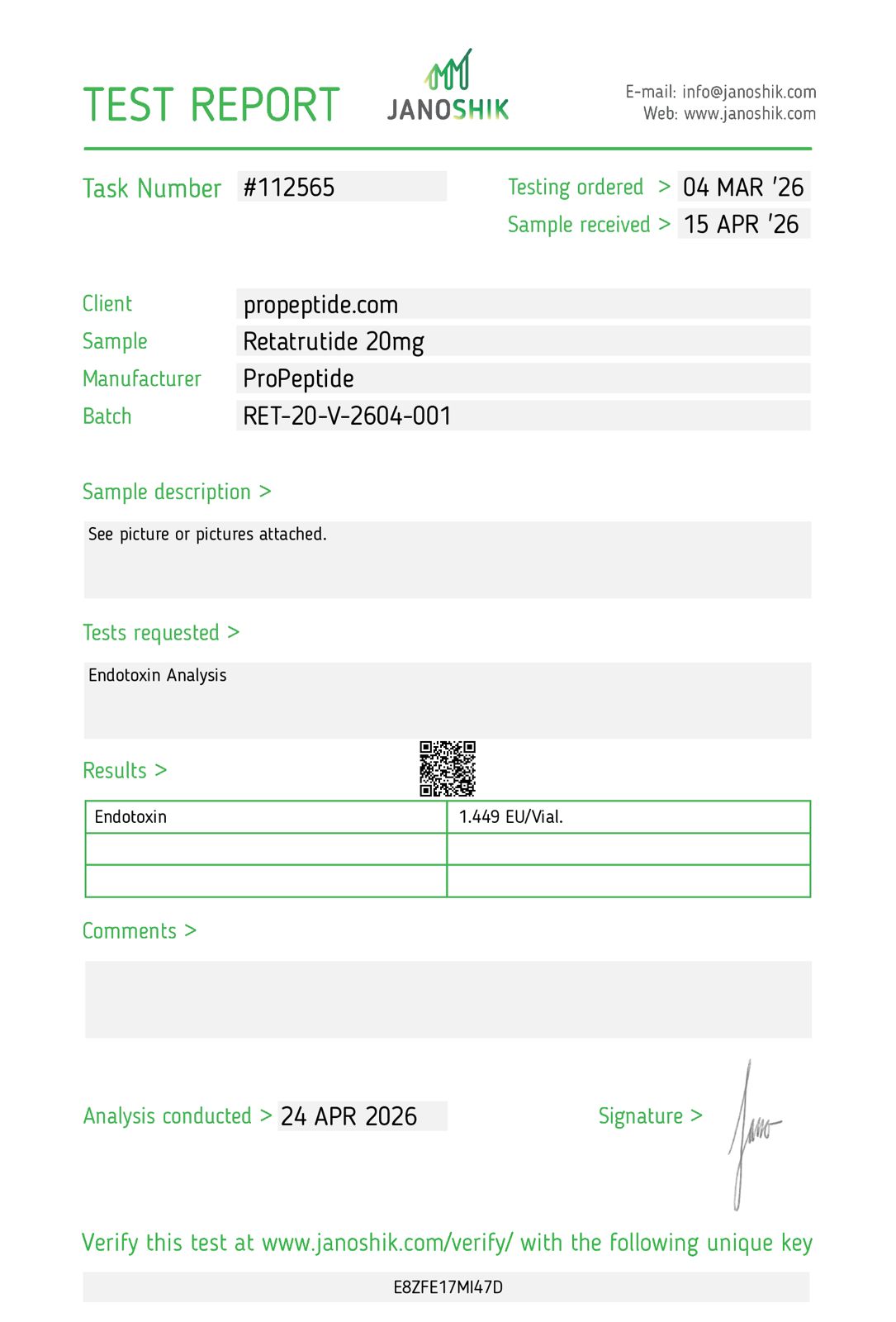
Bacterial endotoxin (LAL). The Limulus Amebocyte Lysate (LAL) test quantifies bacterial endotoxin — lipopolysaccharide fragments that can persist through synthesis and fill steps. RET-20-V-2604-001 measured 1.449 EU/Vial. Endotoxin is the panel most directly relevant to in-vitro cell work that wants to control for confounding immune signalling; publishing the number on a research-use vial is unusual and is what makes the vial line the documentation-first option in the Remy range.
What This Means For Researchers
Retatrutide is a triple-receptor agonist engaging GIP, GLP-1, and glucagon receptors with a single molecule. Triple-agonist potency is highly sensitive to sequence integrity: any truncation or deletion variant alters receptor binding for at least one of the three pathways, which makes HPLC purity verification meaningful, not cosmetic. At 99.741% HPLC, RET-20-V-2604-001 sits in the same band as the rest of the Remy Retatrutide line (30mg pen 99.262%, 20mg pen 99.841%) — inter-batch variation of 0.1–0.6% is normal and reflects analytical precision rather than systematic differences in synthesis.
The 10mg vial is the smaller-quantity format in the vial line and suits shorter or smaller-N research protocols where the full 40mg bulk vial would be larger than the study requires. The HPLC number is what underwrites in-vitro work that compares results to published Eli Lilly trial data on reference-grade material; the heavy metals, residual TFA, and bacterial endotoxin panels speak to the additional confounders that matter in a dry-fill lyophilized format where the dissolved-in-cartridge assumption of the pen line does not apply.
The Full Report
HPLC purity report from Janoshik Analytical for batch RET-20-V-2604-001 (99.741%, verification key YCYA75M373NA).
Bacterial endotoxin (LAL) report from Janoshik Analytical for batch RET-20-V-2604-001 (1.449 EU/Vial, verification key E8ZFE17MI47D). The heavy metals and residual TFA reports are linked from the batch page.
Frequently Asked
What is the HPLC purity of the Retatrutide 10mg Vial?
RET-20-V-2604-001. Assay 20.92 mg retatrutide. Analysis date 21–24 April 2026. The full Janoshik panel is mirrored at /coa/ret-20-v-2604-001/.
What additional panels are tested on the vial line?
RET-20-V-2604-001 for heavy metals (As, Cd, Pb, Hg — all not detected), residual TFA (not detected), and bacterial endotoxin (1.449 EU/Vial by LAL method). Verification keys: YCYA75M373NA for the purity report, E8ZFE17MI47D for the endotoxin report.
Why does the vial line include endotoxin testing when the pen does not?
Does the 10mg vial use the same batch as the 40mg vial?
RET-20-V-2604-001; the 40mg vial now has its own dedicated lot, batch RT-40-V-001, with a fuller Janoshik panel that adds microbial sterility (TAMC/TYMC pass) on top of HPLC, heavy metals, TFA, and endotoxin. The two formats differ in fill quantity — the 10mg vial suits shorter or smaller-N research protocols, while the 40mg vial is the bulk format for extended work.